LORAWAN IoT

LORAWAN Networks

LORAWAN, an acronym for Low Power Long Range Wide Area Network, is a low-speed, low energy consumption and long-range wireless communication technology. LORAWAN makes it possible to offer small, inexpensive IOT sensors, generally battery-powered, which communicate data over large distances. The possibility of deploying numerous sensors locally also makes this technology very economical. These characteristics have opened the door to the deployment of numerous use cases, previously difficult or unprofitable to implement.

A LORAWAN network is a wireless communication network which allows, thanks to the installation of a simple Gateway (LORAWAN Gateway), the communication of several hundred IOT sensors over large distances (up to 20 km).

Communication consumes little energy and allows the sensors to operate on battery power, which avoids the cost and constraints of external power supply
Long distance communication makes it possible to limit the equipment (gateways, antennas) required, making deployment very economical
The cost of this technology is low, and makes it possible to make many use cases profitable until now impossible to “digitalize”.
Mobirise Website Builder

Applications

Fuel infrastructure

Fuel Depot Monitoring

Fuel Level Monitoring: Track fuel levels in tanks, enabling proactive management and reducing the risk of stockouts.
 Leak Detection: Detect potential leaks or anomalies in fuel tanks, minimizing environmental impact and safety risks.
Temperature Monitoring: Monitor fuel temperature to ensure optimal storage conditions.

LoRaWAN Sensor Types
Ultrasonic Sensors: Measure fuel levels using ultrasonic technology.
Float Sensors: Track fuel levels using float-based sensors.
Temperature Sensors: Monitor fuel temperature to ensure optimal storage conditions.

 Real-Time Monitoring: Track fuel levels, temperature, and other parameters in real-time.
Automated Alerts: Receive alerts when fuel levels reach critical thresholds or when anomalies are detected.
Improved Efficiency: Optimize fuel management, reduce waste, and prevent stockouts.

Advantages
Increased Accuracy: Improve fuel level accuracy, reducing errors and discrepancies.
Reduced Costs: Optimize fuel management, reduce waste, and prevent stockouts, resulting in cost savings.
Enhanced Safety: Detect potential leaks or anomalies, minimizing environmental impact and safety risks.


Energy infrastructure

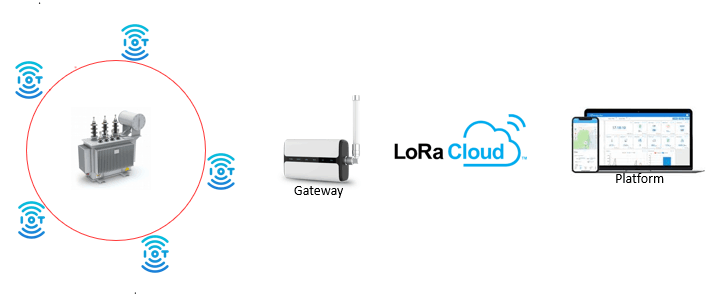
Transformer Health Monitoring & Intrusion Detection

Transformer Health Monitoring: Monitor parameters like temperature, oil level, and load to predict potential issues and schedule maintenance.
Intrusion Detection: Detect unauthorized access or tampering with transformers, enabling swift response and minimizing potential damage.

Temperature Sensors: Monitor transformer temperature to detect potential overheating issues.
Oil Level Sensors: Track oil levels to ensure adequate lubrication and prevent damage.
Vibration Sensors: Detect unusual vibrations that may indicate potential issues or tampering.
Motion Sensors: Detect unauthorized access or movement around transformers.

Advantages
 Real-Time Monitoring: Enable real-time monitoring and alerts, allowing for swift response to potential issues.
 Increased Efficiency: Automate monitoring and reduce manual inspections, improving efficiency and reducing costs.
Enhanced Security: Provide an additional layer of security against potential threats and unauthorized access.


Telecommunications infrastructure

Base StationMonitoring & Intrusion Detection

Power Monitoring: Monitor power consumption, voltage, and current to detect potential issues.
Environmental Monitoring: Track temperature, humidity, and other environmental factors to ensure optimal operating conditions.
Security Monitoring: Detect unauthorized access or tampering with cellular base stations.

LoRaWAN Sensor Types
Temperature and Humidity Sensors: Monitor environmental conditions to ensure optimal operating conditions.
Power Monitoring Sensors: Track power consumption, voltage, and current to detect potential issues.
 Motion and Vibration Sensors: Detect unauthorized access or tampering with cellular base stations.
Door and Access Sensors: Monitor access to cellular base stations and detect potential security breaches.

 Benefits
Remote Monitoring: Monitor cellular base stations remotely, reducing the need for on-site visits.
Real-Time Alerts: Receive real-time alerts for potential issues, enabling swift response and minimizing downtime.
Improved Efficiency: Automate monitoring and reduce manual inspections, improving efficiency and reducing costs.


Contact Us

Phone

+263 777 009 690
+263 242 107 234

Email

support@dtecsystems.co.zw
sales@dtecsystems.co.zw

Address

Suite 303 Executive Chambers 
George Silundika Avenue
Harare
Zimbabwe

Hours Open

Mon-Fri: 9am - 5pm

AI Website Generator